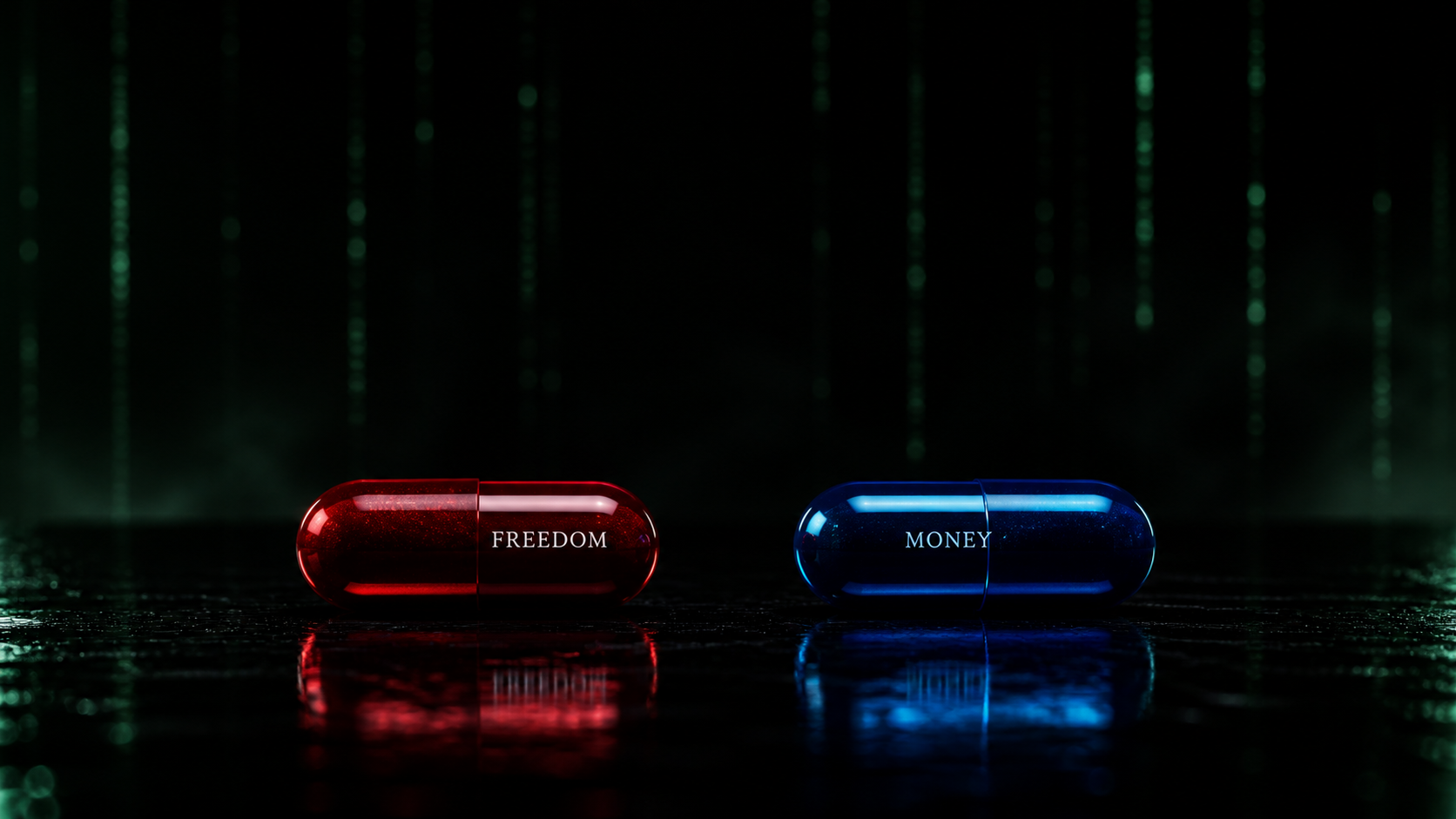
Today I want to talk about something artificial.
Not artificial intelligence.
Something much older.
Something that decides where we live, how we spend our days, what risks we can take, and sometimes even what dreams we are allowed to have.
Money.
We created it. We gave it value. And somehow, after thousands of years, we started building almost our entire lives around it.
Maybe the strangest part is that most of us never stop to ask why.
When I was 12 years old, my father went to prison.
He was the mayor of a small town. I believe he was an honest politician who was treated unjustly. Almost six years of his life passed in prison.
So I learned about freedom much earlier than I wanted to.
I think people who have personally been tested with freedom understand something that is difficult to explain to others.
Money feels powerful when you are free.
But once you understand that your freedom exists inside boundaries created by governments, institutions and other people, money starts looking very different.
Your bank balance is a number inside a system.
Your currency has value because a system says it has value.
Your ability to use it exists because the system allows you to use it.
That doesn’t make money useless.
But it does make it artificial.
Freedom is different.
Money is artificial. Freedom is not.
What if money stops mattering?
Recently, Elon Musk made a prediction that sounds almost absurd.
He argued that AI and robotics could create so much abundance that, in roughly ten years, money may stop being very important.
In other words: around 2036.
Maybe he is wrong.
Actually, when someone gives an exact date for the future, we should probably be skeptical.
But I don’t think the date is the interesting part.
The interesting part is the direction.
What happens when intelligence becomes extremely cheap?
What happens when robots can produce more of the things we need?
What happens when technology continues attacking scarcity?
Our economic system is built around limited resources.
AI is now attacking the scarcity of intelligence.
Robotics is attacking the scarcity of labor.
And technological progress keeps attacking the cost of producing things.
Maybe the important question of this century will not be:
How can everyone become rich?
Maybe it will be:
Why does everyone need to become rich just to live freely? (The Times)
Watch the Elon Musk interview clip on YouTube
Rizq
This idea actually reminds me of something much older than AI.
In Islam there is the concept of rizq — provision.
The Qur’an says:
“There is no moving creature on earth whose provision is not guaranteed by Allah.”
— Qur’an 11:6
Christian scripture gives a beautiful example too.
Jesus asks people to look at the birds.
They do not farm or store food like humans do, yet:
“Your heavenly Father feeds them.”
— Matthew 6:26
And in the Torah, when the Israelites are hungry in the wilderness, God tells Moses:
“I will rain down bread from heaven for you.”
— Exodus 16:4
Three traditions. Different stories and contexts.
But there is an idea inside them that I find beautiful:
Human existence should not be a permanent panic about survival.

Of course, hunger exists.
Poverty exists.
People die because they cannot access things that other people throw away.
So I am not saying we already live in a world of abundance.
We clearly don’t.
But I think there is a difference between saying Earth has limits and saying every case of human suffering is caused by those limits.
Technology keeps increasing what humanity can produce.
Yet access is still deeply unequal.
And that brings us back to the real problem.
Maybe scarcity is not always the enemy.
Sometimes the enemy is how humans distribute power.
Money only works inside its borders
Think about what money actually is.
You can have $100,000 in your account.
But a government can sanction where it moves.
A bank can freeze access.
A payment network can reject a transaction.
A currency can collapse.
A border can change what your money can do.
During the 2026 Iran conflict, Iran even demanded war reparations as part of ceasefire negotiations. The Bitcoin version of this story that spread online is much less clear, so I don’t want to present it as fact. But the real event itself still shows something interesting:
Money is not some law of physics.
It operates inside political systems. (The Wall Street Journal)
And this is one reason I find Bitcoin historically important.
Not because Bitcoin is perfect.
Not because everyone should buy Bitcoin.
And definitely not because number goes up.
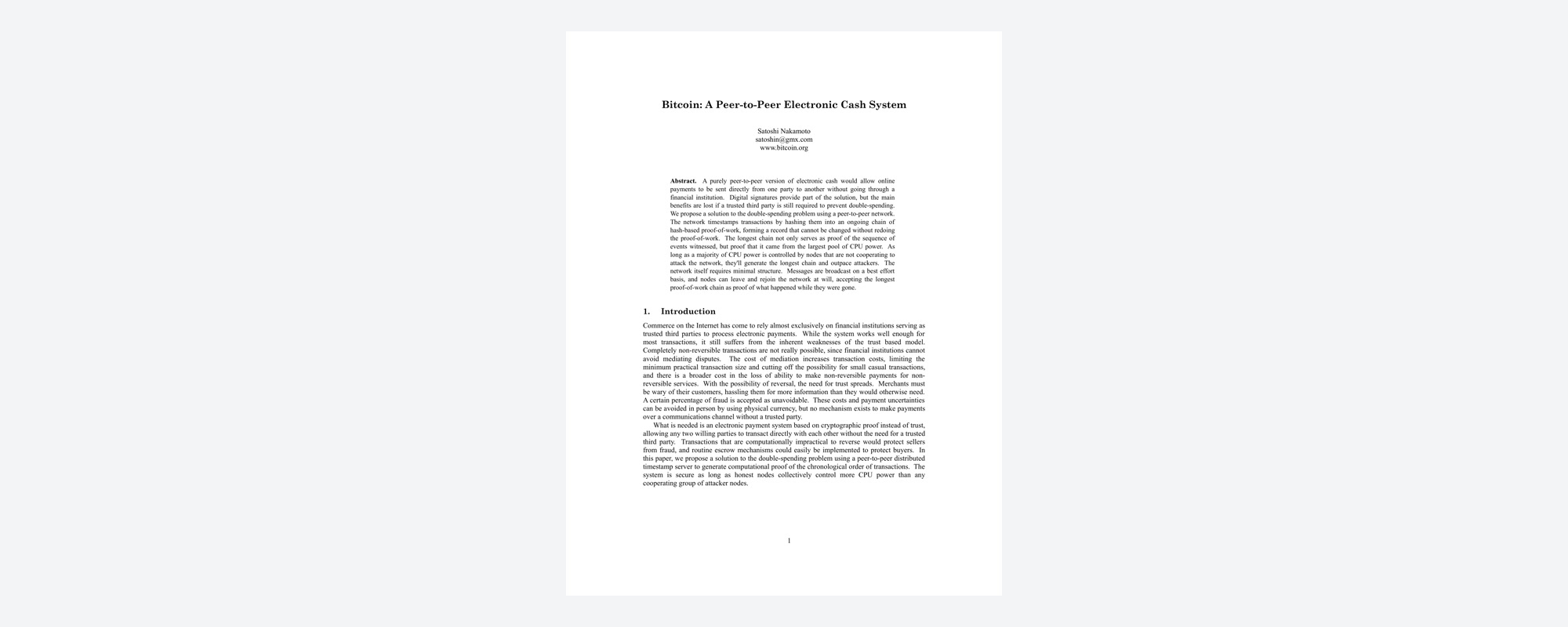
Bitcoin asked a much more interesting question:
Can two people transfer value without asking a central authority for permission?
Suddenly money became a software problem.
And therefore, a freedom problem.

Technology has always been about freedom
Sometimes we talk about technology like it is just about better products.
I don’t think it is.
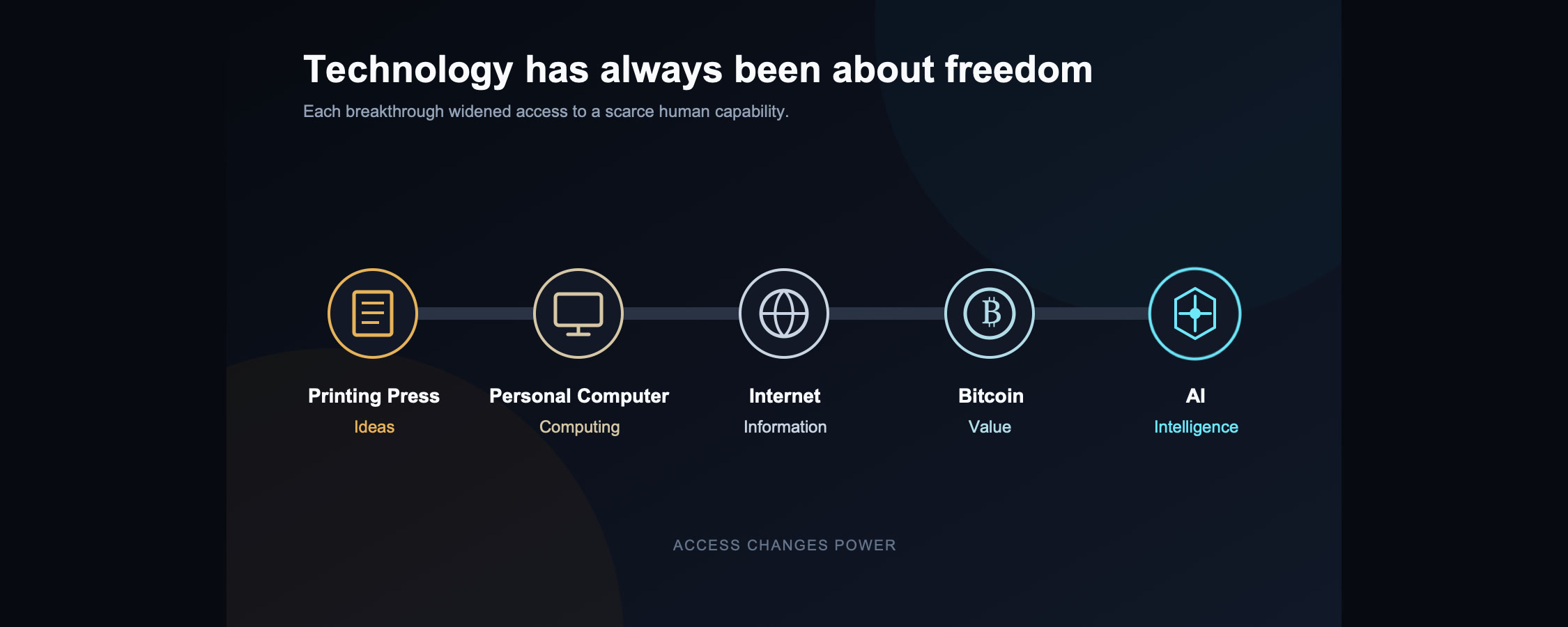
The printing press changed who could spread ideas.
Personal computers changed who could compute.
The internet changed who could publish information.
Bitcoin challenged who could transfer value.
And AI is changing who can access intelligence.
That last one may become more important than all the others.
Imagine if the internet existed, but normal people were allowed to use it for only 30 minutes every day.
Imagine if personal computers existed, but the fastest computers could legally belong only to a few companies.
We would immediately understand that this is not just a technology problem.
It is a power problem.
So why should intelligence be different?
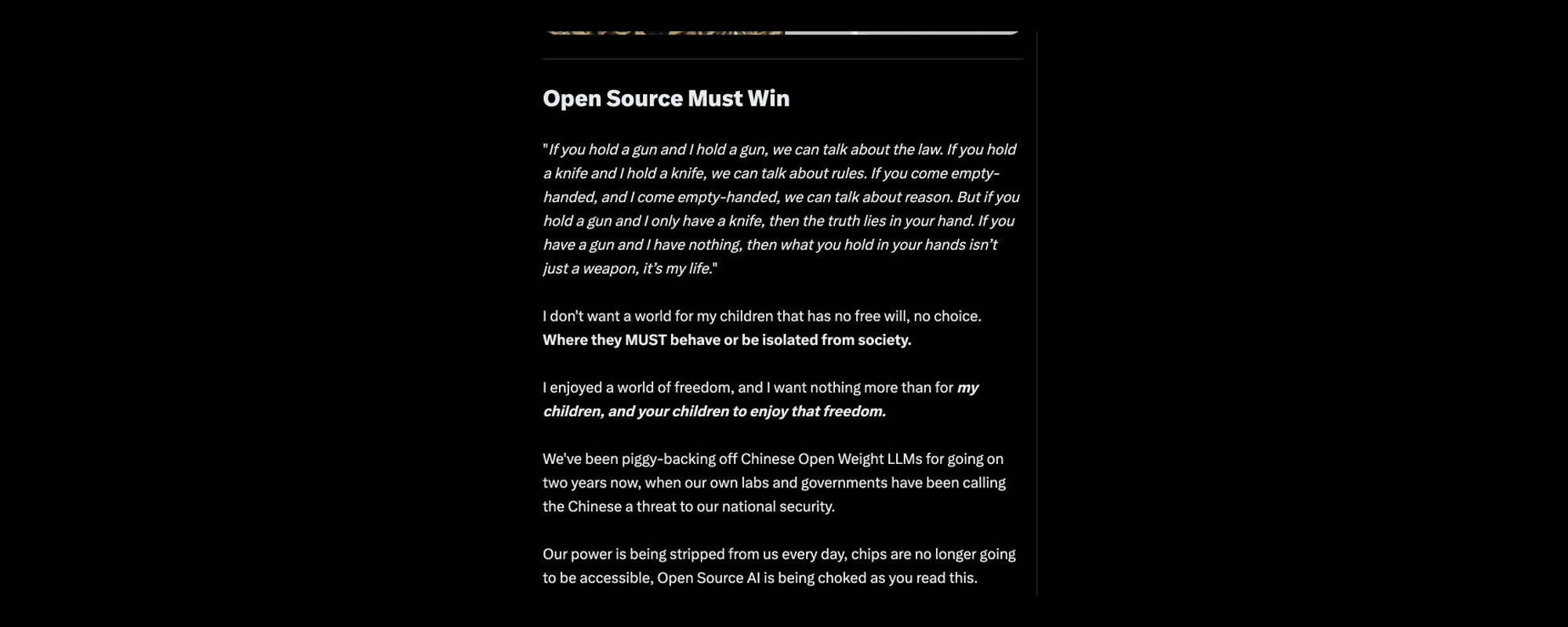
My friend @0xSero has an article called Open Source Must Win.
There is one part that stayed in my head.
He uses an analogy: if both people have equal power, they can talk about rules and reason. But when one side has overwhelming power and the other side has nothing, the conversation changes completely.
And then he explains why this matters to him:
“I don’t want a world for my children that has no free will, no choice.”
I think that sentence captures the real open-source AI debate better than another benchmark chart ever could.
Because this isn’t really about LLMs.
It is about who gets power.
Sero’s mission is to make AI education, training, inference and self-hosting accessible to people regardless of their budget. I don’t agree that we can know exactly how the AI future will develop, but I deeply agree with the principle behind his argument:
frontier intelligence cannot become a privilege reserved for the most powerful institutions on Earth.
Because intelligence can become life and death
This stopped being philosophical for me when I started reading about AI and breast cancer screening.
In March 2026, researchers published a study in Nature Cancer evaluating Google’s mammography AI on 115,973 mammograms.
The AI showed higher sensitivity than the first human reader in that study.
In a simulated workflow, replacing a second reader with AI reduced reading time by 32% while increasing cancer detection by 17.7%. (Nature Cancer)
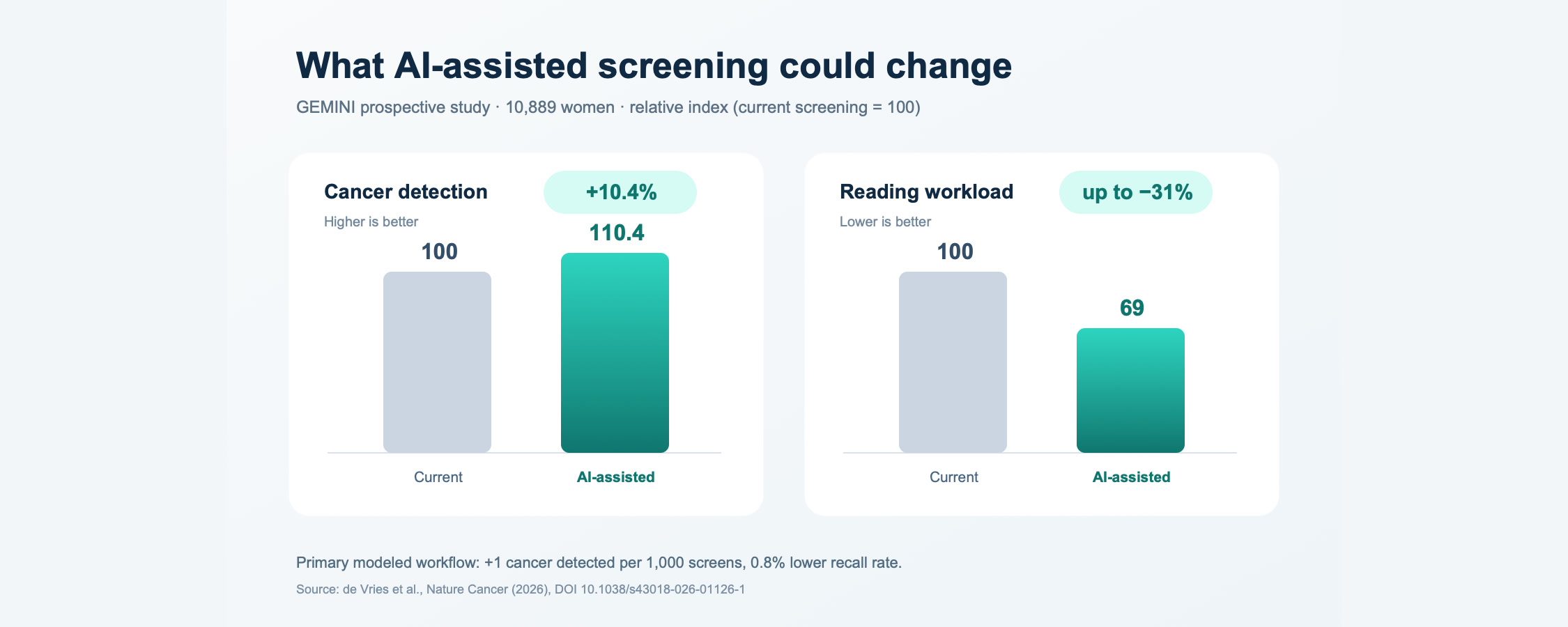
Another prospective study involving 10,889 women found that one AI workflow could increase cancer detection by 10.4% while reducing workload by up to 31%. (Nature Cancer)
Those are numbers.
But I didn’t think about numbers when I read this.
I thought about my mother.
I thought about my sister.

Then I imagined a darker version of this technology.
Imagine that ten years from now, the best medical models can detect some diseases much earlier than the models available to ordinary hospitals.
But only a few corporations can access those models.
Now imagine an insurance company has better intelligence about your future health than you or your doctor.
It predicts a serious disease early.
And instead of using that intelligence to help you, someone uses it to decide that insuring you is no longer profitable.
That scenario is fictional.
I hope it always stays fictional.
But that is exactly why the question of who controls intelligence matters before these systems become even more powerful.
Open models are not important to me because open source sounds cool.
They are important because intelligence is slowly becoming infrastructure.
What are we actually building for?
I am 21 years old and studying computer science.
And there is a question I increasingly ask myself:
What should engineers optimize for?
Money?
Salary?
Valuation?
Users?
Status?
Life is simply too short for money to be the final objective.
Death does not have an age.
If money disappeared tomorrow, I think the things that actually matter would suddenly become much easier to see.
Love.
Peace.
Family.
Friendship.
Freedom.
Helping another human being.
If someone asked me to imagine a universe where everybody loved other people more than themselves, and then asked me to give that universe a name…
I honestly cannot think of a better word than heaven.
Technology should move us closer to that world.
Not further away from it.
Maybe engineers need an oath
Doctors have the Hippocratic tradition.
I sometimes wish engineers had something similar.
Because engineers are no longer only building tools.
We are building systems that decide how billions of people communicate, work, learn, travel, spend money and access intelligence.
Maybe our oath could be much simpler.
I will not build technology only because it makes money.
I will try to build technology that makes humans more free.
Because if engineers cannot live by that ideal, we cannot complain when the future becomes a giant machine optimized only for profit.
We would be the people who built it.

I am still optimistic
My 21 years of life have given me many reasons to think about freedom.
But strangely, they have also given me many reasons to believe in people.
No matter how difficult life became for me or my family, good people appeared.
People we could trust.
After moving to Europe, I understood something even better.
Goodness does not have one religion.
It does not have one language.
It does not have one race.
There are good people everywhere.
And while I know those people exist, being completely pessimistic about humanity almost feels unfair to them.
I don’t know if money will stop mattering in 2036.
I don’t know if Bitcoin will become an important part of the future financial system.
I don’t know how powerful AI will become.
And I definitely don’t know what the world will look like when I am 40.
But I know what I want technology to do.
Give people more freedom.
Give people more knowledge.
Give people more time.
Give a 19-year-old researcher access to intelligence that today belongs to a billion-dollar laboratory.
Give a doctor better tools to save someone’s mother.
Give ordinary people more control over their own lives.
And hopefully, give all of us fewer reasons to spend this very short life fighting each other.
Maybe the most artificial thing shaping our future was never the intelligence.
Maybe it was the thing we spent our entire lives chasing.
Money is artificial.
Freedom is not.
https://youtu.be/5Pk_oHxy15M?si=lZbFIbYXIgA14sTr
Ibrahim S. Akarcesme